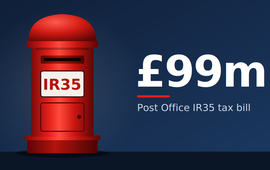
Managing a flexible workforce requires a clear understanding of UK tax compliance. For corporate boards, HR directors, procurement professionals, and finance teams, navigating the off-payroll working rules is an essential part of risk management. Commonly known as IR35, this legislation impacts how organisations engage external talent and determines where the financial liabilities rest.
We outline the core mechanics of the legislation, clarify status definitions, and explain how hiring organisations, agencies, and consultancies can maintain complete compliance.
What is IR35?
IR35 is the standard term for the UK's Intermediaries Legislation and off-payroll working legislation, statutes which are enforced by HMRC to tackle tax avoidance through false self-employment. The rules identify individuals who operate through an intermediary, such as a personal service company (PSC), but whose working practices match those of a conventional employee. These individuals are often referred to as deemed employees.
The legislation was introduced in April 2000 to ensure that workers who engage like employees pay Income Tax and National Insurance. It’s not the nature of the activities that is important, but the capacity in which a person is engaged.
How does IR35 work and who does it affect?
The rules affect three main parties in the supply chain: the hiring business, the intermediary (the company supplying the worker, typically a contractor’s PSC or limited company), and the contractor.
To determine if the rules apply, one must examine the contract and working reality. If the relationship is like an employment relationship, the engagement is subject to employment taxes.
Historically, contractors were responsible for assessing their own status. However, the off-payroll reforms shifted this responsibility entirely. Public sector bodies took on this duty in 2017, and medium and large private sector organisations followed in April 2021. Today, the client is responsible for assessing the status, and the deemed employer is liable for any unpaid tax if that assessment is found to be incorrect.
What does inside IR35 mean?
An engagement classified as inside IR35 means the relationship between the worker and the client is treated as employment for tax purposes. Because the contractor is deemed an employee for tax, they do not qualify for the tax efficiencies available to independent businesses.
When a role is inside IR35, the deemed employer must deduct Income Tax and employee National Insurance Contributions (NICs) from the invoice amount before making payment. The deemed employer is also responsible for paying employer National Insurance Contributions and the Apprenticeship Levy, where applicable.
What does outside IR35 mean?
An engagement classified as outside IR35 means that the contractor is operating a genuine commercial business. The relationship is strictly business-to-business.
For an outside IR35 engagement, the hiring organisation pays the contractor's personal service company the gross invoice amount without deductions. The contractor can then manage their own corporate tax affairs, paying corporation tax on profits and remunerating themselves through a combination of salary and dividends.
To maintain an outside status safely, the contractor will operate a separate enterprise. This includes holding professional business insurance, investing in their own equipment, and maintaining their own corporate identity.
Who carries the financial liability for IR35?
Under the off-payroll working rules, the financial liability generally rests with the deemed employer in the supply chain, which is often the recruitment agency or the end client. If HMRC conducts an audit and determines that an outside IR35 status was given without reasonable care, the client can be held responsible for the back-taxes, interest, and substantial financial penalties.
HMRC has the authority to investigate corporate tax arrangements at any time. Routine enquiries can expand significantly if carelessness is suspected, with investigations potentially stretching back six years.
There is a specific exemption for small businesses in the private sector. When a client qualifies as small, the statutory responsibility to determine IR35 status remains with the contractor. Following the updated thresholds introduced on 6 April 2026, a business is classified as small if it meets at least two of the following criteria:
- An annual turnover of no more than £15 million.
- A balance sheet total of no more than £7.5 million.
- 50 employees or fewer.
Does IR35 apply to limited companies, umbrella companies, and sole traders?
The rules apply specifically to workers operating through an intermediary, which is almost always a personal service company or a limited company where the contractor is a director and fee-earner.
The legislation does not typically apply when engaging contractors through an umbrella company. This is because an umbrella company employs the worker directly and processes their earnings through standard PAYE, removing the risk of deemed employment.
Sole traders are also exempt from IR35 legislation itself because they do not operate through an intermediary company. However, businesses must remain cautious. General employment status rules still apply to sole traders. If a business hires a sole trader who is later deemed an employee by HMRC, the hiring organisation faces direct liability for regular employment taxes.
The IR35 compliance checklist: how is status determined?
Determining employment status depends on case law rather than a statutory test. A robust assessment must weigh several key operational factors.
Indicators of an inside IR35 status:
- Personal service: The contractor must perform the work themselves and cannot provide a substitute.
- Control: The client dictates the specific hours, location, and precise methods used to complete the tasks, which they also dictate.
- Mutuality of obligation: The worker is paid, and the client is obliged to offer continuous work, and the contractor is obliged to accept it.
- Integration: The contractor is treated as part and parcel of the organisation, managing staff, using standard employee facilities, or receiving company perks.
- Financial risk: The client covers the cost of correcting any errors or substandard work.
Indicators of an outside IR35 status:
- Substitution: The contractor has an authentic, contractually backed right to send a qualified replacement to perform the services.
- Autonomy: The contractor decides how, what, when, and where to deliver the agreed project outcomes.
- Project-focused: The engagement is tied to specific deliverables or a fixed price, rather than open-ended time.
- Business infrastructure: The contractor uses their own specialised equipment, maintains distinct branding, and works for multiple clients simultaneously.
- Commercial risk: The contractor is financially liable for the project and must correct any defective work at their own expense.
Frequently asked questions about IR35
Will IR35 be scrapped?
No. While there has been significant political debate surrounding the off-payroll reforms over the years, the government has maintained the rules to protect tax revenue. The primary tax legislation is a permanent fixture, and businesses must ensure they have reliable compliance processes in place.
How do I know if IR35 applies to a specific contract?
Hiring organisations must issue a Status Determination Statement (SDS) for every engagement. This document must state the final decision and outline the detailed reasons behind it. To protect the business, this assessment must be conducted with reasonable care, taking into account both the written contract terms and the actual operational practices.
Can a contractor dispute an IR35 decision?
Yes. Contractors have a statutory right to challenge a Status Determination Statement if they believe the assessment is incorrect. The hiring business must provide a formal, client-led disagreement process. The organisation is required to review the appeal and deliver a reasoned response within 45 days, either confirming the original decision or issuing a new statement.
Protect Your Business with IR35 Shield
Managing off-payroll compliance does not have to be a burden on your HR, procurement, or finance teams. At IR35 Shield, we provide market-leading automated assessment tools backed by over two decades of experience in enquiries and tribunals. Our robust solutions deliver definitive results, helping your business secure top freelance talent while mitigating tax risks.
We’re here to support you and your business every step of the way. If you need help with your IR35 processes, feel free to reach out. You can email us at info@ir35shield.co.uk or get in touch with an expert to find out how we can help.