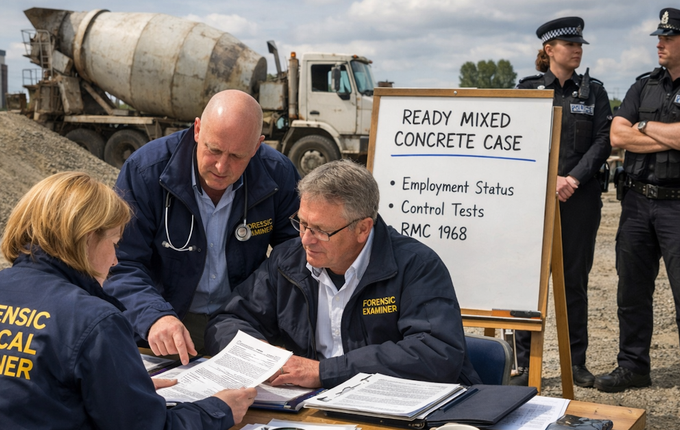
A recent employment tribunal decision involving medical professionals engaged by the Metropolitan Police offers important insight into the way control is often argued in tax status disputes. In Dr J Payne-James and Others v Commissioner of Police of the Metropolis, the tribunal made clear that regulatory and operational controls, even in a highly controlled environment, do not, without more, amount to a sufficient framework of employment-type control for status purposes.
For tax advisers grappling with HMRC status enquiries (e.g. IR35, off-payroll working and sole trader cases) where "control" is asserted based on policies, procedures, or professional regulation, the case is a valuable reminder that factual findings concerning control should ask why control exists and what it is capable of achieving, not merely whether it can be identified. The tribunal's reasoning undermines the assumption that regulatory compliance can serve as evidence of deemed employment.
Whilst this was a rights case, the same employment status test applies for tax purposes, and the tribunal's detailed findings of fact provide a valuable evidential reference point in disputes where HMRC seeks to infer employment from regulatory or operational controls affecting freelance shift workers.
Ready Mixed Concrete – 3 stages
In status disputes between taxpayers and HMRC, the battleground is often control, in particular, whether HMRC can demonstrate a sufficient framework of control at RMC Stage 2. Control examines whether the hirer can control what work is done, where it is done, when it is done, and how it is done.
The "control argument" emanates from Ready Mixed Concrete (South East) Ltd v Minister of Pensions and National Insurance [1968] 2 QB 497 ("RMC"), which includes the long-accepted approach to determining employment status. RMC has three Stages; the first two are preconditions. If they do not trigger, the engagement cannot be employment.
The first precondition is that personal service and the irreducible minimum of mutuality of obligation (payment) must exist; the second stage requires a "sufficient framework of control." Once those are met, the third stage requires all factors to be considered in the round, including the degree (or extent) of control.
A potted history of control
HMRC has historically adopted a view of control based on a curious interpretation from the Upper Tier case in Weight Watchers (UK) Ltd v HMRC [2011] UKUT 433 (TCC); [2012] STC 265. For many years, HMRC had used Weight Watchers to argue that control was a binary switch at Stage 2, causing a default finding of employment, and that control should not be revisited at RMC Stage 3.
That view was quashed in April 2022 in the Court of Appeal case of CRC v Atholl House Productions Ltd [2022] EWCA Civ 501, where the court recognised "mutuality of obligation and the right of control as necessary preconditions to a finding that a contract is one of employment" and Lord Richards stated "Nor do I think it appropriate to add a gloss of a "prima facie affirmative conclusion" of a contract of employment."
In September 2024, the Supreme Court in Revenue and Customs v Professional Game Match Officials Ltd [2024] UKSC 29 ratified those principles and referenced Uber BV v Aslam [2021] UKSC 5, [2021] ICR 657, when referring to "second forms" of control which could be considered at Stage 2. The Supreme Court stated that "the bar to the existence of control need not be set at an unduly high level."
Second forms refer to situations where an engager does not direct how work is carried out day to day, but instead exerts indirect influence through incidental or collateral matters which sit alongside the work, such as audit processes, quality assurance, or regulatory oversight. The critical question is whether such mechanisms confer a real and enforceable right to direct performance, including the ability to impose disciplinary consequences, or whether they are mere governance, risk management, or professional regulation that may not suffice.
The focus on regulatory control arose most notably in the Upper Tier in Christa Ackroyd Media Ltd v Revenue and Customs [2019] UKUT 326 (TCC), where the appellant sought to argue unsuccessfully that "Control by the BBC which was exercised for regulatory purposes was not relevant to the control test for employment purposes."
The evolution of control in those cases left many status advisors believing that the height of the "sufficient framework of control" bar at Stage 2 was so low as to be almost meaningless, since some form of regulatory control is present almost everywhere.
But the police case took a different view, by drilling down into the detailed cross-examination and exploring the single determinative question: why?
Why 'what happens' is not enough
In tax enquiries, HMRC frequently seeks to satisfy stage 2 of RMC by pointing to policies, handbooks, or regulatory constraints, without addressing where those controls originate from, or whether they are employment-type controls.
A shallow approach to exploring control can lead to failing to distinguish what happens from why it happens. As Lord Justice Popplewell has repeatedly emphasised, including in Jaffe & Anor v Greybull Capital LLP & Ors [2024] EWHC 2534 (Comm), reliable fact-finding requires understanding causation and context, not merely surface description. In employment status cases, this distinction is critical. Controls arising from professional regulation, statutory obligations, or risk governance cannot be assumed to evidence subordination unless their rationale is examined.
Without testing why a worker complies with a rule or process, whether out of professional duty, regulatory necessity, or genuine contractual or managerial direction, there is a risk of drawing false conclusions about the presence of employer control.
Let's now look at the facts, then see how Judge Kenward applied the "why" to the appellants' claims of control through various regulatory apparatuses.
The facts
The claimants were Forensic Medical Examiners ("FME"), who provided custodial healthcare services to the Metropolitan Police. They brought claims in the Employment Tribunal on the basis that they were employees or workers under the Employment Rights Act 1996.
The FMEs worked as independent professionals, hired on a casual basis and able to choose when and where they worked, facilitated by a rota process agreed on a shift-by-shift basis. They could agree on a shift and cancel without sanction. Their clinical work was undertaken exercising independent medical judgment, subject to GMC standards rather than managerial direction.
There were standard operating procedures (SOPs) for the FMEs to follow regarding security, administration, and medication disposal. FMEs were also expected to use the National Strategy for Police Information Systems (NSPIS) for electronically recording case information.
There were also annual training and CPD requirements for FMEs that needed to be obtained to do the work, which the FMEs were required to book and fund themselves at their own time and expense, using whichever provider they chose.
But did Judge Kenward consider the facts that evidenced a sufficient framework for control at RMC Stage 2?
Tribunal says no
The tribunal observed that the shifts were offered based on FME availability, but that there was no obligation to offer or accept work. Where FMEs were making clinical decisions, the FMEs retained full clinical autonomy, which the Police could consider but could not direct medical judgments.
In relation to SOPs, NSPIS recording, and CPD requirements, the tribunal drew a critical distinction. These measures existed because of the custody environment, not because the Police were directing how the FMEs performed their work. They were required to discharge statutory duties around detainee welfare and medication safety, not to supervise or manage the FMEs as workers.
Overall, the control existed to manage risk, not to supervise performance. The controls were operational safeguards rather than employment-type controls, and lacked disciplinary enforcement typical of employment.
The tribunal concluded that "…the limited extent of any control of the FMEs did not amount to a sufficient framework of control so as to be commensurate with an overarching employment contract."
The bar at RMC stage 2, which was considered lowered by the Supreme Court in PGMOL, was not reached by tapping into potential second forms of control.
From the front line
For seasoned status experts who argue cases with HMRC and defend at tribunal, the arguments traversed are not new. Whilst noting that this is a rights case, not a tax case, and that it does not set precedent, the arguments are persuasive.
It is not enough to observe that there are controls in place; one has to ask what they are, why they are there, and whether they are employment-type controls. Simply observing that there is control tells you nothing about the cause or the reason why. For example, control emanating from obligations to the General Medical Council is obviously not employer-type control if the employer isn't required to enforce them. Likewise, an individual might go out of their way to satisfy a client who keeps asking for assistance at short notice. But the reason the individual agrees to those requests isn't that they are legally obligated to, it's because the independent individual wants to satisfy the client and maintain a good working relationship.
Key takeaway
For advisers, this decision reinforces a crucial message: control must be examined in light of its source, purpose, and effect.
Regulatory compliance, professional standards, and risk management do not automatically equate to employment-type control. While this is a rights case rather than a tax precedent, its reasoning is likely to resonate strongly in HMRC disputes where control is asserted without examining causation or legal effect.