In summary:
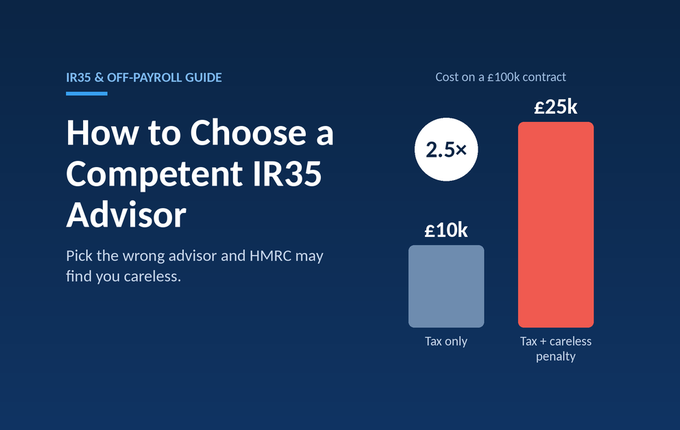
- A careless HMRC finding can make an IR35 mistake up to 2.5 times more expensive.
- Relying on an advisor who isn't competent can itself count as careless.
- This guide shows you how to tell a competent IR35 advisor from the rest.
The competency of the advisor you rely on for IR35 and off-payroll decisions can make the difference between a manageable tax bill and one that is two and a half times bigger.
This guide is for HR, procurement, and compliance teams that engage contractors, explains the case law on competency, and compares different suppliers.
If HMRC decides a contractor should have been treated as a deemed employee ("Inside IR35"), your firm owes the extra tax due. But if HMRC also finds you were careless, meaning you did not take reasonable care, it can add additional penalties. You may be considered careless by HMRC if you relied on advisors who are not competent.
The penalties are large because they are calculated on the full tax bill, before taking into account ("offsetting") the tax the contractor has already paid.
The table below shows the impact on a single £100,000 contract using illustrative ballpark figures:
| Approximate cost | |
|---|---|
|
Full tax bill, before credit for tax the contractor already paid (about 50% of fees) |
£50,000 |
|
Offset amount, assuming contractor paid corporation tax and dividend tax on the contract earnings, and corporation overpayment relief is available. |
£40,000 |
|
Tax you actually pay, after offsets |
£10,000 |
|
Prompted careless penalty, 30% of the full £50,000 |
£15,000 |
|
Total cost if found careless (Excluding interest) |
£25,000 |
As shown above, a careless finding can more than double the cost. That is why you must be able to show you took reasonable care, and why the competence of your chosen advisor matters so much.
How do you take reasonable care?
You take reasonable care by following an informed, evidenced and ongoing process, not by always reaching the right answer. The question is whether the loss of tax was brought about by a failure to take reasonable care.
The standard comes from Collis v HMRC [2011] UKFTT 588 (TC). It asks what a prudent and reasonable taxpayer, in the taxpayer's position and exercising reasonable diligence, would have done.
Most firms rely on an advisor using tools to help reach their determinations. That reliance counts as reasonable care only if it meets the test in Hanson v HMRC [2012] UKFTT 314 (TC): the source is competent for the task, the firm was given full and accurate facts, and the firm engaged with the output as far as its own knowledge allowed.
If the advisor fails the first limb on competence, the firm's reliance on it can itself be careless. Choosing a competent advisor is therefore a key foundation of reasonable care.
Example: HMRC penalties in the public sector
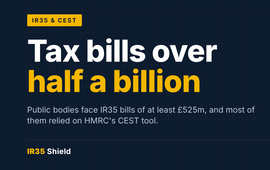
Public sector bodies have been issued IR35 tax bills of over £525m, and some have been charged penalties for failure to take reasonable care. A Freedom of Information request by IR35 Shield shows why Natural Resources Wales (NRW) was penalised:
"HMRC have concluded that the customer did not take sufficient care in making sure they followed HMRC's guidance or take steps to engage externals in the field to give them advice when making the determinations."
Failing to bring in outside specialists contributed to the careless finding.
What is a competent IR35 advisor?
Relying on an advisor or tool counts as reasonable care only if the source is competent for the task at hand. Hallmarks of a competent IR35 advisor are:
- Specialist IR35 knowledge. HMRC expects you to choose advisers who are trained and competent for the specific task, and to check that the firm you deal with actually knows the subject. The most experienced IR35 advisors will know the statute and extensive case law, not just HMRC guidance, and will have experience handling IR35 status enquiries and representing taxpayers at tax tribunals.
- Relevant qualifications or proven experience. Membership of a recognised body can indicate competence, but experience can also demonstrate it. For IR35, look for a track record with HMRC enquiries and tax tribunals, and check the adviser's reputation and history, as HMRC's own guidance recommends.
- Gives advice you can rely on. A competent advisor reaches a clear, reasoned conclusion and is candid about genuine risks.
- Clear terms and insurance. A professional advisor charges for their advice, sets out the scope of the work in written terms of engagement that you sign, and holds professional indemnity insurance typically up to £1,000,000. That gives you a remedy if the advice proves wrong, which anonymous free advice cannot offer.
Types of advisors
Firms offering IR35 help fall into broad types, and only the first is built to meet the competent-advisor test end to end.
- Specialist IR35 advisories. Firms focus on IR35 and off-payroll working and have proven experience, knowledge of the case law, a track record in HMRC IR35 status enquiries, and experience defending cases at the tax tribunal. They are registered with HMRC as tax advisors, have terms you will sign, and Professional Indemnity cover for IR35 advice of at least £1,000,000.
- General accountants and advisors. Whilst competent across tax generally, they often do not have in-depth knowledge of IR35 case law, nor experience of IR35 enquiries or tribunals. Many will tell clients that status is a specialist matter and not for them to advise on, which signals the need to seek specialist help.
- Recruitment agencies. These vary, but most have no in-house IR35 expertise, no experience dealing with HMRC IR35 status enquiries, and aren't HMRC-registered tax advisors. They can, of course, hire competent advisors to help them.
- Software-only IR35 providers. Firms with no depth of experience in IR35 or tax that have built tools using AI or programmers with no IR35 knowledge. They cannot deal with HMRC enquiries or represent clients at tribunal, and their terms typically state that their service cannot be relied upon as formal IR35 tax advice. Some are anonymous, and it's unknown who is behind them. Reliance on them would be careless.
Comparing the solutions
Only a specialist IR35 advisory can typically tick every must-have attribute; the other types fall short on enquiry experience, legal depth and the ability to stand behind their advice. The tables show what each supplier type typically offers, so check any individual provider against them.
|
Attribute |
Specialist IR35 advisory (e.g. IR35 Shield) |
General accountant or advisor |
Recruitment agency Or Software-only provider |
|---|---|---|---|
|
Registered with HMRC as a tax adviser |
Yes |
Yes |
No |
|
Handled HMRC IR35 & off-payroll compliance checks (enquiries and tax tribunal) |
Yes |
Rarely |
No |
|
Knowledge of relevant status case law, statutory interpretation, contractual interpretation and construction |
Yes |
Unlikely |
No |
|
Professional indemnity insurance covering IR35 tax advice of at least £1,000,000. |
Yes |
Yes |
No |
|
Can provide written formal IR35 legal opinions |
Yes |
Rarely |
No |
Why choose IR35 Shield
IR35 Shield is a high-end, advisor-driven specialist that focuses solely on IR35 and off-payroll working. Hundreds of customers choose IR35 Shield.
- Front-line experience. We have assisted with many HMRC enquiries and tax tribunals, and we have closed HMRC compliance checks.
- Proven results. Multiple customers have satisfied HMRC compliance checks quickly, with closure in months rather than years. This shows our full-service offering keeps misclassification risk low and satisfies HMRC.
- Specialist-led technology. We created the first online IR35 status test in 2009. Our software streamlines specialist-led advice; it doesn't replace it.
- Core service. Our IR35 assessments include unlimited software support and account management.
- Underwritten protection. We are underwritten by top-rated insurer Markel, and offer an underwritten tax investigation service.
Key Learning Point
Choosing an IR35 tax advisory is part of how HMRC judges whether you took reasonable care. Relying on an advisor who is not competent can be careless in itself, and a careless finding can increase your HMRC bill for non-compliance by up to two and a half times.
A specialist firm with a proven track record in IR35 status matters, including enquiry and tribunal experience, backed by a professional indemnity policy, is the surest way to demonstrate reasonable care and minimise the risk of being careless.