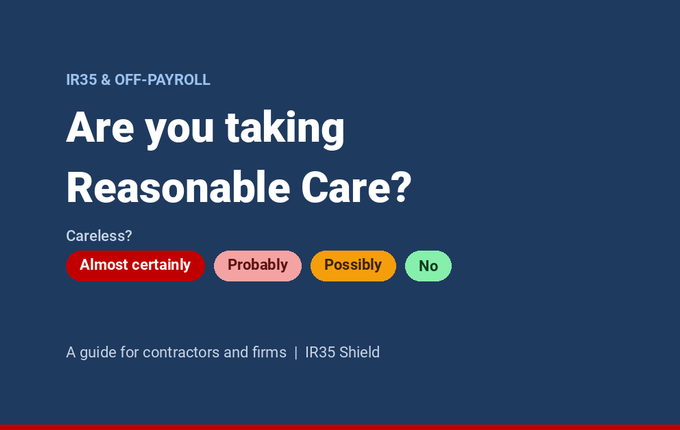
Whether you are a contractor or a firm engaging contractors, you take reasonable care on IR35 by following an informed, evidenced, ongoing process, not by reaching the right answer. Getting status wrong costs tax; getting the process wrong also costs penalties for carelessness and extends HMRC's enquiry window from four years to six. Carelessness means not taking reasonable care.
- Weakest positions: ignoring IR35 altogether, ignoring an adviser's recommendation to get specialist help, or relying on advice from sources that lack credibility or competence. All three are close to automatic carelessness.
- Strongest positions: Use of an expert-built tool such as IR35 Shield, backed by a proven specialist IR35 tax advisory, with accurate answers, retained evidence and regular review.
- HMRC's Status Tool (CEST) presents a paradox. HMRC promises to stand by its results, yet twelve public bodies have disclosed over £525m in off-payroll tax bills, and used CEST. The MoJ, Home Office and Natural Resources Wales were also penalised for carelessness, and the Cabinet Office also faces a careless penalty of up to £8.9m.
The legal framework for Reasonable Care
The test is whether the inaccuracy or loss of tax was brought about by a failure to take reasonable care. It governs careless-inaccuracy penalties under Schedule 24 FA 2007 and HMRC's extended six-year discovery window under s36(1) TMA 1970.
The standard. Collis v HMRC [2011] UKFTT 588 (TC) asks what a prudent and reasonable taxpayer, in this taxpayer's position and exercising reasonable diligence, would have done. A contractor trading through a personal service company (PSC) is expected to know IR35 exists; it has been in force since April 2000. A firm engaging contractors is expected to know the off-payroll rules, which have applied to public bodies since April 2017 and to medium and large private sector clients since April 2021.
Five features that decide most cases
- Wrong is not careless. A wrong conclusion reached through a reasonable process is not automatically careless.
- Causation. The carelessness must have brought about the loss.
- Burden of proof. HMRC must prove carelessness to charge a careless penalty or rely on the extended time limit.
- The taxpayer's position. The standard reflects the person's knowledge, experience and circumstances.
- Reliance on others. Hanson v HMRC [2012] UKFTT 314 (TC): reliance is reasonable where the source is competent, was given full and accurate facts, and the taxpayer engaged with the output as far as their own knowledge allowed. This is the right lens for advisers and for tools.
Who is liable
Where the client is small, Chapter 8 ITEPA 2003 applies, and the obligation sits with the intermediary (the PSC), acting through its director. Officers can be made personally liable for the company's penalties under para 19 Sch 24 only if the inaccuracy was deliberate.
Where the client is a public body or a medium or large private sector firm, Chapter 10 applies. The client must decide status and should give a Status Determination Statement (SDS), and s61NA ITEPA 2003 requires it to take reasonable care in reaching that conclusion. A statement made without reasonable care is not an SDS, and the client is then treated as the deemed employer liable for the tax.
What is at stake
| Behaviour |
Discovery time limit (TMA 1970) |
Inaccuracy penalty range (Sch 24 FA 2007) |
|---|---|---|
| Reasonable care taken | 4 years (s34) | None |
| Careless | 6 years (s36(1)) | 15%–30% of potential lost revenue |
| Deliberate, not concealed | 20 years (s36(1A)) | 20%–70% |
| Deliberate and concealed | 20 years (s36(1A)) | 30%–100% |
Eight Reasonable Care scenarios: where do you stand?
The strongest positions involve using experts; the weakest are ignoring IR35 or ignoring advice to get specialist help. The scenarios apply to a contractor assessing their own status or a firm assessing a contractor it engages. Find the row that matches your current approach. Each assessment assumes the engagement turns out to be inside IR35; if it is outside, there is no loss and carelessness does not arise.
| # |
What the contractor or firm does |
Careless? | Why |
|---|---|---|---|
|
1 |
Does not consider IR35 at all |
Almost certainly
|
A contractor should know IR35 exists, and a firm engaging contractors should know the off-payroll rules apply. Doing nothing is definitely careless. |
| 2 | Is told to seek specialist advice; does not |
Almost certainly
|
Ignoring a professional warning is the textbook example of failing to take reasonable care. |
| 3 | Considers it alone; no advice, nothing written down |
Probably
|
No record of seeking help or thought put into the decision is likely to be considered careless. |
| 4 | Accountant says they cannot help; does it themselves |
Probably
|
The adviser declining signals a specialist matter. A reasonable taxpayer would look for someone who can help. |
| 5 | Uses an online tool not built or backed by tax experts |
Probably
|
Fails the first Hanson limb if the tool/advice is anonymous or not backed by competent advisors. |
| 6 | Writes an amateur analysis not aligned with HMRC guidance |
Possibly
|
A superficial analysis ("I have a substitution clause") shows effort but also shows that whoever wrote it was out of their depth and should have sought advice. |
| 7 | Uses HMRC's CEST tool |
Possibly
|
Public sector bodies have used HMRC's CEST tool, and HMRC has found them careless and applied penalties. |
| 8 | Uses expert-built tools and services such as IR35 Shield |
No
|
Closest to relying on a competent adviser under Hanson. |
CEST: a special case
CEST is the one tool HMRC promises to stand by, yet public bodies that used it have still been charged over £525m and, in many cases, penalised for carelessness. For a contractor or firm, using CEST does not guarantee reasonable care, nor can it be relied on to produce an answer HMRC agrees with.
The CEST guidance page now says HMRC will stand by all results as long as the information given remains accurate and is in accordance with its guidance. HMRC's commitment ties the result to its own non-statutory guidance, not the law, and CEST has no legal authority. Its logic has not changed since November 2019, despite HMRC losing on key principles in cases in April 2022 and September 2024, and it gives no answer in 20% of cases.
CEST use has fallen by more than two-thirds since its peak, according to HMRC data released to IR35 Shield under Freedom of Information requests.
The practical lesson: CEST is not statutory, HMRC is not legally bound to accept a CEST result, and using it could mean failing to take reasonable care and incurring penalties. Your fate depends entirely on whether an HMRC inspector, whose job it is to collect tax revenue, agrees with the answers.
What is a competent IR35 advisor?
Relying on an advisor or tool counts as reasonable care only if the source is competent for the task at hand. HMRC's guidance (which aligns with case law) refers to a taxpayer using a competent professional who is given a full and accurate set of facts, then checks the advice as far as they can, and adopts it.
Hallmarks of a competent IR35 advisor
- Specialist IR35 knowledge. HMRC expects you to choose an adviser who is trained and competent for the specific task, and to check that the individual you deal with actually knows the subject. The most experienced IR35 advisors will know the statute and extensive case law, not just HMRC guidance, and will have experience handling IR35 status enquiries and representing taxpayers at tax tribunals.
- Relevant qualifications or proven experience. Membership of a recognised body can indicate competence, but experience can also demonstrate it. For IR35, look for a track record with HMRC enquiries and tax tribunals, and check the adviser's reputation and history, as HMRC's own guidance recommends.
- Gives advice you can rely on. A competent advisor reaches a clear, reasoned conclusion and is candid about genuine risks.
- Clear terms and insurance. A professional advisor charges for their advice, sets out the scope of the work in written terms of engagement that you sign, and holds professional indemnity insurance typically up to £1,000,000. That gives you a remedy if the advice proves wrong, which anonymous free advice cannot offer.
What contractors and firms should do
You can show you are taking reasonable care if your process is informed, evidenced and ongoing.
- Do the assessment. Ignoring IR35 is the clearest route to a careless finding and six years of exposure.
- Use a competent advisor. Choose a specialist provider with proven expertise in IR35, who has defended IR35 status enquiries all the way to the tax tribunal. Avoid anonymous advice, which will almost certainly be considered careless.
- Keep the evidence. Save all relevant information, including what you used for the assessment, and keep email exchanges for future reference.
- Act on warnings. If an accountant or tool flags uncertainty, get specialist advice. Ignoring that advice is close to automatic carelessness.
- Review regularly. Reassess whenever the role changes. Firms should also check that working practices still match the determination throughout the engagement.
Reasonable care starts with the advisor you rely on. Anonymous advice offers no protection, and proven credentials are crucial. Choosing HMRC's free CEST tool could be the most expensive decision you make.