A competent IR35 advisor specialises in IR35 and off-payroll working, knows the case law and HMRC guidance, has handled HMRC status enquiries and tax tribunals, and stands behind its advice with signed terms and professional indemnity insurance.
The choice matters because HMRC can treat reliance on a non-competent advisor as careless, which could at least double your IR35 tax bill.
This guide is for HR, Finance, Procurement and Compliance teams in businesses that engage contractors through their own limited companies.
Why does your choice of IR35 advisor matter?
Your choice of IR35 advisor matters because HMRC treats reliance on advice as reasonable care only when the advisor is competent for the job. If the advisor isn't competent, relying on them can be careless, and a careless finding adds penalties and lets HMRC look back six years instead of four.
Most businesses rely on a specialist advisor, often using software, to reach their status decisions. That reliance protects you when three things are true: the advisor is competent for IR35, you gave them full and accurate facts, and you checked their advice as far as your own knowledge allowed. The first qualifier is decided the day you choose who to work with.
Our guide to reasonable care under IR35 explains the wider standard.
How much can a careless finding add to an IR35 bill?
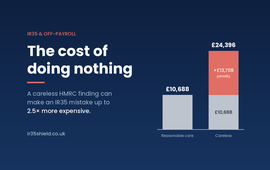
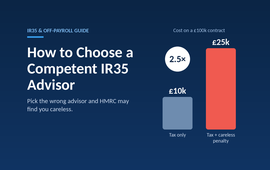
A careless finding can make an IR35 mistake around two and a half times more expensive. The penalty is calculated on the full tax bill, before any credit for tax the contractor has already paid, so it can be larger than the tax you end up owing.
Here is a rough illustration for a single £100,000 contract:
| Item | Approximate cost |
| Full tax bill, before credit for tax the contractor already paid (about 50% of fees) | £50,000 |
| Credit for corporation tax and dividend tax the contractor already paid | £40,000 |
| Tax actually payable after the credit | £10,000 |
| Careless penalty at 30% of the full £50,000 | £15,000 |
| Total cost if found careless, excluding interest | £25,000 |
The credit assumes the contractor's company paid its taxes and that relief for overpaid corporation tax is available. Without a careless finding, the bill in this example would be £10,000.
What makes an IR35 advisor competent?
A competent IR35 advisor has specialist IR35 knowledge, a proven record with HMRC enquiries and tax tribunals, gives clear, reasoned advice, and works on signed terms backed by professional indemnity insurance. HMRC's own guidance expects you to choose an advisor trained for the specific task and to check that they know the subject.
What to look for:
- Specialist IR35 knowledge. They know the legislation and the relevant case law.
- Proven experience. A track record of handling HMRC status enquiries and representing businesses at tax tribunals.
- Advice you can act on. They reach clear conclusions, explain why, and are open about any real risks.
- Proper terms and insurance. They charge for advice, set out the scope in written terms you sign, and hold professional indemnity insurance, typically up to £1,000,000. That gives you a remedy if the advice is negligent.
What happens if you don't use a competent advisor?
If you make IR35 decisions without competent help and HMRC later disagrees, you are more likely to be found careless and charged penalties on top of the tax. Public bodies have learned this the hard way: they have faced more than £525m in IR35 tax bills, and some were also penalised for carelessness.
One example is Natural Resources Wales. A Freedom of Information request by IR35 Shield showed HMRC concluded it had not taken sufficient care, including failing to bring in outside specialists to advise on its determinations.
What types of IR35 advisors are there, and how do they compare?
There are four broad types of IR35 advisors: specialist IR35 advisories, general accountants, recruitment agencies and software-only providers. Only a specialist IR35 advisory is typically built to meet every part of the competence test, including enquiry and tribunal experience and insurance that covers IR35 advice.
- Specialist IR35 advisories focus on IR35 and off-payroll working. They know the case law, have handled HMRC status enquiries and defended cases at tribunal, are registered with HMRC as tax advisors, work on signed terms and carry professional indemnity cover for IR35 advice.
- General accountants are competent at a high level across tax but often lack depth in IR35 case law and experience of enquiries or tribunals. Many will tell you status is a specialist matter, which is your cue to find specialist help.
- Recruitment agencies vary, but most have no in-house IR35 expertise, no experience of HMRC status enquiries and aren't registered tax advisors. If they offer IR35 services, they can bring in competent advisors to help.
- Software-only providers sell tools built without IR35 specialists behind them. They can't handle HMRC enquiries or represent you at a tribunal, and their terms usually say the output isn't formal tax or legal advice. Some are anonymous. Relying on them is highly likely to be seen as careless.
What each type typically offers (check any individual provider against this):
| What to check | Specialist IR35 advisory | General accountant | Recruitment agency or software-only provider |
| Registered with HMRC as a tax advisor | Yes | Yes | No |
| Has handled HMRC IR35 enquiries and tax tribunals | Yes | Rarely | No |
| Knows IR35 case law and how contracts are interpreted | Yes | Unlikely | No |
| Professional indemnity cover for IR35 advice of at least £1,000,000 | Yes | Yes | No |
| Can give a formal written IR35 opinion | Yes | Rarely | No |
Frequently asked questions
Who pays the tax if HMRC decides a contractor is inside IR35?
For off-payroll, where the client is medium or large, it depends on whether the client did its job properly. A client that hasn't made a careful status decision, or hasn't passed its Status Determination Statement to the contractor and the next party in the supply chain, stays liable for the tax. Once it has done both properly, responsibility for PAYE and National Insurance moves to the fee-payer, usually the agency. Where the client is small, the contractor’s company is liable.
Does following HMRC guidance prove we took reasonable care?
No. HMRC guidance is HMRC's opinion of the law and has no legal standing with tribunals or courts. IR35 status is decided by the legislation and the case law that interprets it, so a process built only on HMRC guidance can leave gaps. A competent advisor works from the law itself.
Can we rely on HMRC's CEST tool instead of an advisor?
CEST is free and optional, but relying on it alone is risky. A CEST result doesn't consider your contract or explain your reasons, so on its own it isn't a Status Determination Statement. HMRC is not bound by CEST results, and public bodies that used it have still been found careless.
Do we have to use an IR35 advisor?
No law requires you to use an advisor, but you should take reasonable care over every status decision. Making decisions alone, without specialist help and without anything written down, is likely to be seen as careless. If your accountant says IR35 is outside their expertise, that signals you should bring in a specialist.
How IR35 Shield helps
IR35 Shield is a specialist advisory that works on IR35 and off-payroll working. We have handled many HMRC enquiries and tax tribunals and closed HMRC compliance checks for our customers, often within months. Our software, first launched as an online IR35 status test in 2009, supports our specialists' advice rather than replacing it, and our Tax Investigation Service is underwritten by Markel.
If you need help with your IR35 processes, feel free to reach out. You can email us at info@ir35shield.co.uk or get in touch with an expert to find out how we can help.